A hybrid can look clean in photographs and still leave important questions unanswered. That matters when you’re choosing a daily commuter for Dar es Salaam traffic, air-conditioning, uneven roads and heavy rain.
The Japanese auction sheet is one of your most useful documents before payment. It can reveal the car’s identity, mileage, visible damage and repair history. It cannot independently certify the hybrid battery. Use this used hybrid inspection checklist in Tanzania to decide what to check, which questions to ask and when a vehicle needs more evidence before you proceed.
Quick Answer
- An auction sheet shows the recorded mileage, auction grade, model details, damage marks and inspector comments.
- It can reveal repair, corrosion, flood or odometer concerns.
- It cannot prove battery health, inverter condition or long-term hybrid reliability.
- Match the chassis number across every document and request separate hybrid-system evidence before payment.
What Can a Japanese Auction Sheet Tell You?
A Japanese auction sheet records a vehicle’s identity, auction condition and visible history. The Tanzania Trade Portal says import duties and taxes depend partly on the vehicle’s brand, engine size and production year (Tanzania Trade Portal, Vehicle Import Procedure, accessed August 13, 2026). That makes accurate identification important before you compare costs.
 The auction sheet is useful evidence, but it must be read alongside the vehicle photographs and inspection reports.
Which Identity Details Should You Confirm?
Start with the chassis number, model code, year information, engine capacity, fuel type, transmission and drivetrain. Also check the odometer reading, auction date and any registration details shown on the sheet. Check which of these fields appear on the specific sheet, then cross-match them against the export certificate, inspection report and vehicle photographs.
The chassis number links the document to one specific vehicle. The model code helps separate similar-looking variants. Engine capacity and production year can affect the Tanzania cost estimate. Fuel type remains important for confirming that the vehicle has been classified correctly.
JEVIC’s vehicle inspection services describe checks that can help confirm identity, condition and non-conformities (JEVIC, Vehicle Inspection Services, accessed August 13, 2026). Those details are useful for checking whether the paperwork describes the same car, but confirm which fields appear on the specific report.
What Condition Information Does the Sheet Provide?
The sheet may include an overall auction grade, interior and exterior assessments, an inspector’s written comments and a body diagram. The diagram marks scratches, dents, corrosion, repaired panels and replaced parts.
Read the written comments carefully. They may explain a problem that photographs do not show clearly. A clean-looking panel can still have a repair mark, paint variation or previous replacement.
Citation capsule: A Japanese auction sheet is best treated as a condition and identity record, not a complete mechanical diagnosis. JEVIC’s sample certificate demonstrates that inspection documents can record vehicle identity and non-conformities, while Tanzania Trade Portal guidance shows why year and engine capacity matter for import decisions. Both sources were accessed August 13, 2026.
Auction-Sheet Markings That Deserve Caution
Repair marks, corrosion, flood indicators and inconsistent mileage deserve closer attention than the headline grade. Common auction-sheet guides describe symbols such as R, RA, W, S, C, X and XX, but meanings can vary between auction formats (JP Sheet, How to Read a Japanese Auction Sheet, accessed August 13, 2026).
| Marking or detail |
What it may indicate |
What you should ask |
| R or RA |
Repair or accident history, depending on the auction convention |
What was repaired, and where? Confirm the sheet’s own legend. |
| X or XX |
A component may need replacement or may have been replaced |
Was the work completed correctly? |
| W |
A repair mark, panel wave or uneven body surface |
Is the issue cosmetic or structural? |
| S or C |
Rust or corrosion noted by the inspector |
Is it surface-level or deeper? |
| Flood or water-damage note |
Possible electrical, interior or high-voltage risk |
Has a separate flood inspection been completed? |
| Low interior grade |
Heavy use, staining or interior damage |
Does it fit the stated mileage and age? |
Do not treat every symbol as universal. The sheet’s own legend and a professional translation should take priority. Secondary guides can explain common terminology, but they should not replace the original document.
Small scratches or dents may be manageable when they are fully documented. Structural repairs, heavy corrosion, flood exposure and unexplained electrical warnings deserve much more caution. Why accept a vague answer when the repair history could affect future costs?
 A clear paper trail helps you ask better questions before committing to an imported hybrid.
Citation capsule: Auction grades and damage symbols are screening tools, not guarantees. JP Sheet’s guide explains common marks for scratches, dents, repairs, rust and replaced panels, while also showing why buyers must read the full body diagram and inspector comments instead of relying on one grade. The guide was accessed August 13, 2026.
Can an Auction Sheet Prove That the Hybrid Battery Is Healthy?
No. An auction sheet can reveal warning lights, accident history or flood indicators, but it cannot replace a hybrid-system diagnostic check. NHTSA explains that a traction battery is different from a vehicle’s 12-volt battery and should not be serviced without specialist training and equipment (NHTSA, Electric and Hybrid Vehicles, accessed August 13, 2026).
Which Checks Are Separate?
Think about four separate questions:
- General auction condition: What do the body, interior, mileage and visible defects show?
- Hybrid-system operation: Are there warning lights, diagnostic codes or unusual operating comments?
- High-voltage battery condition: Is there evidence about battery performance, cell balance and cooling?
- 12-volt battery condition: Is the smaller support battery healthy?
The auction sheet may mention warning lights or abnormal operation if the inspector observed them, along with signs of accident or water damage. It usually cannot establish battery state of health, cell imbalance, inverter condition, cooling-fan blockage or long-term battery durability without separate diagnostics.
JEVIC lists structural, odometer and vehicle-function inspections separately (JEVIC, Vehicle Inspection Services, accessed August 13, 2026). A separate hybrid-system diagnostic should be requested from a suitably equipped hybrid technician; do not assume a general pre-shipment inspection includes battery state-of-health testing.
High-voltage systems also need proper safety procedures. The UK government’s MOT manual warns that testers must take care around hybrid high-voltage components and wiring (GOV.UK, MOT Inspection Manual: Introduction, accessed August 13, 2026).
NHTSA also warns that standing water can create high-voltage shock and fire risks in flooded hybrid and electric vehicles (NHTSA, Hurricane- and Flood-Damaged Vehicles, accessed August 13, 2026). Dar’s wet season does not make every hybrid unsafe, but it makes flood history worth checking carefully.
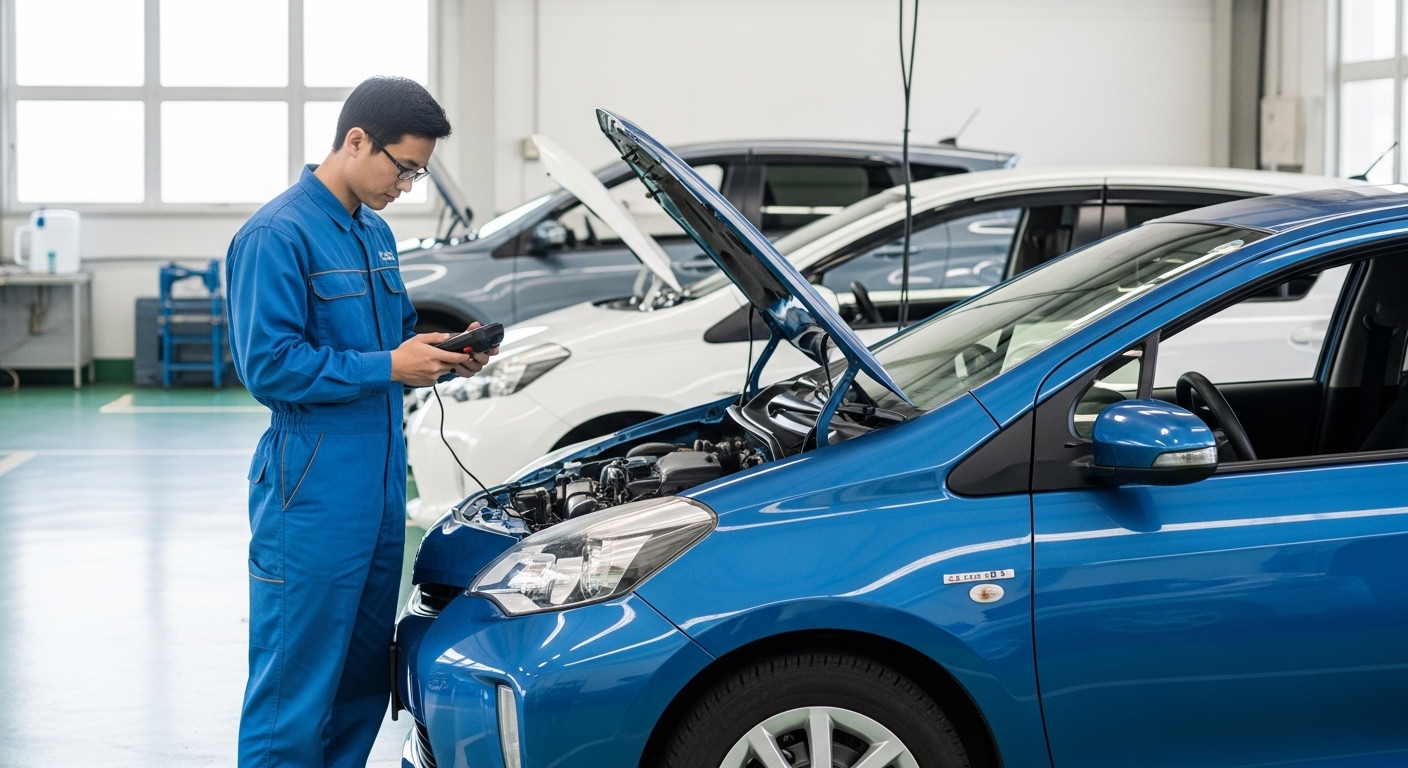 A diagnostic scan can answer questions that a general auction-sheet grade cannot.
Citation capsule: A clean auction sheet cannot independently prove hybrid battery health. NHTSA distinguishes the high-voltage traction battery from the 12-volt battery, while JEVIC lists structural, odometer and vehicle-function inspections separately from the general vehicle-inspection service. Ask for a separate hybrid-system diagnostic, including its test method, date and result, instead of accepting an unexplained battery percentage.
How Should You Compare a Toyota Aqua, Honda Fit and Nissan Note?
Compare the inspection evidence, not just the badge. Toyota’s official Aqua catalogue separates models first sold from 2011 to 2021 from the generation introduced in 2021, and lists a 1,490cc engine for current versions (Toyota Japan, Aqua Vehicle Catalogue, accessed August 13, 2026). One generation’s specifications should not be used as a proxy for another.
| Example |
Identity checks |
Inspection focus |
| Toyota Aqua |
Confirm generation, model code, engine size, drivetrain and battery generation |
Repair marks, corrosion, warning lights and evidence for that generation |
| Honda Fit |
Confirm whether the exact vehicle is petrol or hybrid, then verify its variant |
Body repairs, interior wear and system-specific comments |
| Nissan Note |
Confirm whether the exact unit is petrol, CVT, e-POWER or another configuration |
Powertrain description, warning lights and repair history |
The model name alone is not enough. A Honda Fit listing may be petrol or hybrid. A Nissan Note labelled hybrid should not automatically be described as e-POWER without confirming the exact powertrain.
The same caution applies to the Aqua. Older examples may use different engine and battery systems from newer models. Confirm the model code, engine code, fuel type and generation on the actual vehicle documents.
Citation capsule: Toyota’s official Aqua catalogue separates two major generations and lists different model specifications across them. The catalogue was accessed August 13, 2026. That is why Aqua, Fit and Note examples should be compared through their exact model code, fuel type, engine capacity and inspection evidence, not through the badge alone.
Documents to Request Before Payment
Before payment, connect the vehicle’s identity, auction condition, inspection result and Tanzania cost estimate. JEVIC’s vehicle inspection guidance explains that inspection services can help assess vehicle condition and identity (JEVIC, Vehicle Inspection Services, accessed August 13, 2026). Check which identity and condition fields appear on the specific documents you receive.
Use this checklist:
- Original auction sheet: Request the complete sheet, not only a translated summary.
- Chassis-number match: Compare the number across the auction sheet, photographs and inspection documents.
- Auction photographs: Check whether the images support the damage map and written comments.
- Odometer evidence: Ask how the mileage was checked and recorded.
- Exact specification: Confirm the year, engine size, fuel type, model code and drivetrain.
- Hybrid inspection evidence: Ask whether warning lights, battery-related components and the hybrid system were checked separately.
- Pre-shipment report: Confirm what the inspection covers and when it was completed.
- Landed-cost estimate: Check a vehicle-specific estimate rather than guessing from the advertised vehicle price.
The auction sheet does not calculate Tanzania duty. It only helps establish which vehicle is being assessed. If the year or engine size is wrong, the cost estimate may be based on the wrong assumptions. Fuel type still needs to match the vehicle’s classification and documents.
Keep the documents together so the vehicle identity and cost assumptions can be checked.
Citation capsule: Before payment, a buyer should connect four pieces of evidence: the original auction sheet, matching chassis number, separate inspection information and a vehicle-specific landed-cost estimate. JEVIC’s inspection guidance shows the identity fields that can be checked, but it does not make every inspection a battery state-of-health test.
When Should You Pause or Walk Away From a Hybrid Import?
Pause the purchase when the vehicle’s identity, damage history or hybrid condition cannot be verified clearly. NHTSA’s flood-damage guidance says musty smells, waterlines, mud, dirt and unusual corrosion can indicate previous flooding (NHTSA, Hurricane- and Flood-Damaged Vehicles, accessed August 13, 2026).
Proceed With Normal Clarification
- Cosmetic scratches or small dents are documented.
- The chassis number matches across the documents.
- Mileage, model code and photographs are consistent.
- Hybrid-system evidence is available or clearly requested.
Ask for More Evidence
- R or RA markings are unexplained.
- Repair photographs do not show the full affected area.
- A battery test is mentioned without a date, method or result.
- Interior condition does not fit the stated mileage.
- The powertrain description is unclear.
Pause or Walk Away
- Chassis numbers do not match.
- The auction sheet is missing, cropped or unreadable.
- Flood or heavy corrosion indicators are unexplained.
- Structural damage is not properly documented.
- Hybrid warning lights have no credible explanation.
- The quoted cost does not separate the import charges.
A lower grade is not automatically a rejection. A documented dent is different from unexplained flood damage or structural distortion. The key rule is simple:
If the document tells you what happened but not how it was repaired, ask for more evidence before deciding.
How Can Carbarn Help You Review a Hybrid Before Ordering?
Carbarn helps Tanzanian buyers review Japanese vehicles through live vehicle pages, where the available evidence can include an official auction sheet, an in-house inspection report, auction grade, odometer, vehicle specifications and pre-shipment inspection information. Check the relevant vehicle page for the named inspection provider and the exact scope of that report. The how the Japan-to-Tanzania buying process works page explains the order, payment, inspection and shipping steps.
For examples, compare Toyota Aqua inspection information and Honda Fit inspection information. For a Nissan Note, use a current live vehicle page and confirm the exact fuel type and powertrain before comparing it.
The all-inclusive USD vehicle price covers the vehicle, shipping and inspection. Import duty, VAT and customs clearance are separate customer costs. Use the vehicle page’s Estimated landed cost in Tanzania panel for a real estimate, then review the Tanzania import rules and duty structure.
Citation capsule: Carbarn’s buying guide says buyers can review the auction sheet and in-house inspection report before payment, while live vehicle pages provide vehicle-specific evidence and an estimated landed-cost panel. That evidence helps connect condition checks with the separate costs of importing a hybrid to Dar es Salaam.
Sources and Retrieval Notes
Sources were checked on August 13, 2026. Technical, regulatory and commercial references include the Tanzania Trade Portal, JP Sheet auction-sheet guide, JEVIC vehicle inspection guidance, the Toyota Japan Aqua catalogue, NHTSA electric and hybrid vehicle guidance, NHTSA flood-damaged vehicle guidance, GOV.UK hybrid inspection guidance, the Carbarn buying guide, Toyota Aqua inspection information, Honda Fit inspection information, and Carbarn Tanzania import rules. Each source was retrieved 2026-08-13.


